
← Research index
Thymosin Beta-4 Fragment (TB-500)
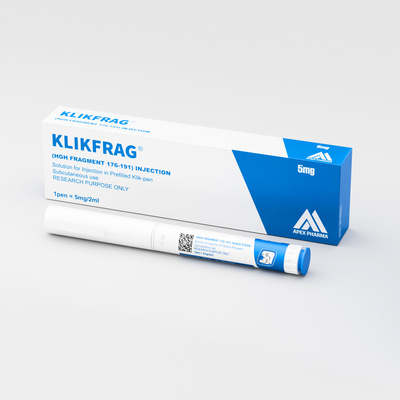
KLIK500 5mg
Cellular migration, tissue remodelling, angiogenesis, wound healing and connective tissue biology.
§ 01
Overview
KLIK500 5mg is based on research surrounding Thymosin Beta-4 (Tβ4) and its synthetic peptide fragment commonly referred to as TB-500. Thymosin Beta-4 is a naturally occurring peptide consisting of 43 amino acids that is found in nearly all nucleated cells throughout the body. It plays an important role in cellular organisation, wound healing, tissue maintenance and embryonic development.
Scientific interest in Thymosin Beta-4 stems from its involvement in one of the body's most fundamental biological processes: cellular repair following injury. Unlike growth factors that stimulate specific signalling pathways, Thymosin Beta-4 appears to regulate the movement and organisation of cells by interacting with actin, one of the primary structural proteins responsible for cell shape and movement.
Research over the past two decades has investigated the role of Thymosin Beta-4 in skin repair, corneal healing, cardiac injury, tendon repair, skeletal muscle regeneration, peripheral nerve recovery and angiogenesis. Much of this evidence originates from laboratory and animal studies, while human clinical investigations have largely focused on ophthalmology and wound healing.
Although experimental findings have generated considerable scientific interest, many proposed applications remain investigational and require further validation through large, well-controlled human clinical trials.
§ 02
Scientific Background
SCIENTIFIC BACKGROUND
Thymosin Beta-4 was first identified within the thymus but was later found to be expressed throughout virtually every tissue in the human body. It is now recognised as one of the most abundant intracellular actin-binding proteins.
Rather than functioning as a traditional hormone, Thymosin Beta-4 acts primarily within cells where it contributes to:
• Cytoskeletal organisation
• Cell migration
• Cell differentiation
• Wound repair
• Blood vessel formation
• Inflammatory regulation
Because tissue repair depends heavily on coordinated cellular movement, researchers have investigated whether increasing Thymosin Beta-4 activity may influence regenerative processes following injury.
MOLECULAR BIOLOGY
The parent Thymosin Beta-4 molecule contains 43 amino acids. TB-500 refers to a synthetic peptide fragment developed to investigate whether selected biological activities of the full-length protein could be reproduced in experimental models.
Although TB-500 is widely discussed in research communities, much of the published literature investigates full-length Thymosin Beta-4, rather than the synthetic fragment specifically. When interpreting published studies, it is important to distinguish between research involving the naturally occurring protein and research involving synthetic peptide analogues.
§ 03
Mechanism of Action
Unlike receptor-selective peptide therapeutics, Thymosin Beta-4 primarily functions by regulating the intracellular actin cytoskeleton. Its biological effects therefore arise from changes in cellular behaviour rather than activation of a single signalling receptor.
Current research suggests involvement in:
• Actin sequestration
• Cell migration
• Angiogenesis
• Stem cell recruitment
• Extracellular matrix remodelling
• Inflammatory regulation
ACTIN REGULATION
Actin exists in two principal forms:
• G-actin (globular actin) — individual actin molecules.
• F-actin (filamentous actin) — structural filaments forming part of the cytoskeleton.
Thymosin Beta-4 binds to G-actin, helping regulate the availability of actin monomers required for cytoskeletal remodelling. This process influences cell movement, cell division, tissue repair, wound closure and mechanical stability. Because cellular migration is fundamental to tissue regeneration, actin regulation has become one of the most extensively studied aspects of Thymosin Beta-4 biology.
CELLULAR MIGRATION
Following injury, multiple cell types migrate into damaged tissue — fibroblasts, endothelial cells, keratinocytes, immune cells and stem/progenitor cells. Experimental studies suggest Thymosin Beta-4 may facilitate coordinated migration during tissue repair.
ANGIOGENESIS
Angiogenesis is essential for successful tissue regeneration. Several experimental studies suggest Thymosin Beta-4 influences VEGF, endothelial cell migration, capillary formation and tissue perfusion. Animal studies frequently demonstrate increased vascularisation within healing tissues; whether these observations translate into clinically meaningful improvements in humans remains uncertain.
§ 04
Human & Preclinical Research
CONNECTIVE TISSUE RESEARCH
Connective tissues possess relatively limited blood supply compared with many other tissues, contributing to prolonged healing following injury. Animal studies have investigated Thymosin Beta-4 in relation to tendon injury, ligament injury, skeletal muscle damage, cartilage repair and bone healing — evaluating collagen organisation, mechanical strength, fibroblast proliferation and extracellular matrix remodelling. Most evidence remains preclinical.
SKIN AND WOUND HEALING
One of the strongest human evidence bases for Thymosin Beta-4 involves wound repair. Clinical and experimental studies have investigated dermal wound healing, corneal epithelial repair, burns, surgical wounds and chronic ulcers. Laboratory research suggests the peptide may promote re-epithelialisation, support extracellular matrix organisation and modulate inflammatory responses during healing. Several ophthalmology studies have reported encouraging findings relating to corneal surface repair, although additional large-scale investigations remain necessary.
CARDIOVASCULAR RESEARCH
Experimental cardiology has explored Thymosin Beta-4 following myocardial injury, examining cardiomyocyte survival, neovascularisation, stem cell activation, myocardial remodelling and fibrosis regulation. Animal studies have demonstrated improvements in several markers of cardiac repair; human confirmation remains limited.
SKELETAL MUSCLE RESEARCH
Researchers have investigated the role of Thymosin Beta-4 in skeletal muscle regeneration following mechanical injury, surgical trauma, exercise-induced damage and experimental muscle degeneration — focusing on satellite cell activation, muscle fibre regeneration, inflammatory signalling and functional recovery. Additional human studies are required.
PERIPHERAL NERVE RESEARCH
Experimental studies have explored whether Thymosin Beta-4 influences axonal regeneration, Schwann cell migration, functional recovery and neuromuscular repair. These investigations remain primarily preclinical.
HUMAN CLINICAL EVIDENCE
Compared with many experimental peptides, Thymosin Beta-4 has undergone limited human investigation. Most clinical research has focused on ophthalmology, corneal epithelial injury, chronic wound healing and skin repair. Evidence supporting musculoskeletal applications remains substantially more limited, and large randomised controlled trials evaluating tendon, ligament or muscle recovery have not yet established definitive clinical benefit.
§ 05
Pharmacology
The pharmacokinetic properties of synthetic TB-500 remain incompletely characterised.
Areas requiring additional investigation include:
• Absorption
• Distribution
• Tissue penetration
• Elimination
• Biological half-life
• Dose-response relationships
Much of the available pharmacological knowledge relates to endogenous Thymosin Beta-4 rather than synthetic peptide preparations.
§ 06
Safety & Research Limitations
SAFETY PROFILE
Published human safety information remains relatively limited. Clinical investigations involving Thymosin Beta-4 have generally reported acceptable short-term tolerability. Researchers continue evaluating long-term exposure, immunogenicity, cellular proliferation, off-target biological effects and chronic administration. Further clinical investigation is required to establish comprehensive long-term safety data.
RESEARCH LIMITATIONS
Several important limitations affect interpretation of the current evidence:
• Predominantly animal research
• Limited musculoskeletal human trials
• Incomplete pharmacokinetic data
• Differences between full-length Thymosin Beta-4 and TB-500
• Variable experimental methodologies
As a result, caution is required when extrapolating laboratory findings to human clinical applications.
§ 07
Future Research
Current scientific priorities include:
• Tendon biology
• Ligament regeneration
• Cardiac repair
• Chronic wound management
• Corneal regeneration
• Stem cell biology
• Precision regenerative medicine
Understanding how actin-regulating peptides influence tissue repair remains an important area of regenerative research.
§ 08
Key Scientific Takeaways
- Thymosin Beta-4 is a naturally occurring 43-aa actin-binding peptide expressed in nearly all nucleated cells.
- TB-500 is a synthetic fragment developed to explore selected biological activities of full-length Tβ4.
- Primary mechanism: G-actin sequestration and cytoskeletal remodelling — influencing cell migration, angiogenesis and stem-cell recruitment.
- Strongest human evidence sits in ophthalmology and dermal wound healing; musculoskeletal human data remain very limited.
- Pharmacokinetics of synthetic TB-500 are incompletely characterised — long-term safety data are lacking.
§ 09
Selected References
- Goldstein AL, Kleinman HK. Thymosin Beta-4: Repair, Regeneration and Regenerative Medicine.
- Malinda KM, et al. Thymosin Beta-4 Accelerates Wound Healing.
- Philp D, et al. Thymosin Beta-4 in Tissue Repair.
- Wound Repair and Regeneration.
- Journal of Cell Biology.
- Nature Reviews Molecular Cell Biology.
- Frontiers in Cell and Developmental Biology.
Standard Research Disclaimer
All Apex Performance compounds are supplied strictly for in-vitro laboratory research use only. They are not drugs, foods, cosmetics, or dietary supplements, and are not intended for human or animal consumption, diagnosis, treatment, cure, or prevention of any disease. Content on this page summarises published scientific literature for educational reference and does not constitute medical advice or a product claim. Purchasers assert they are qualified professionals acting within applicable law.