
← Research index
Tirzepatide (dual GIP / GLP-1 receptor agonist)
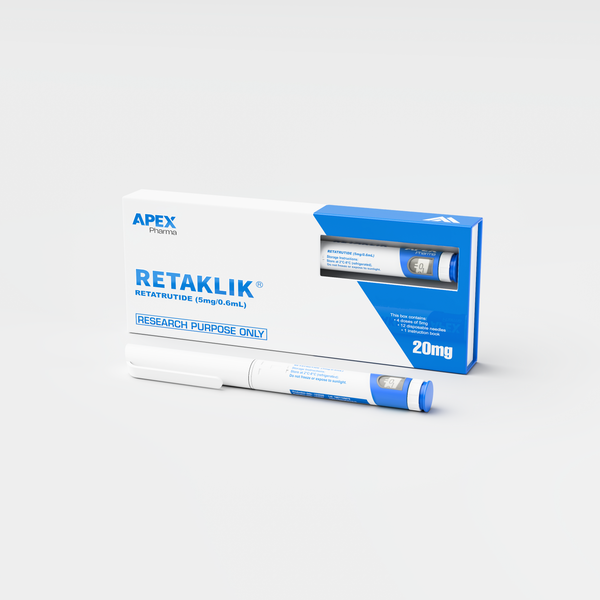
RETAKLIK 20mg
Dual incretin receptor agonism — one of the most extensively studied peptides for glycaemic control, body-weight reduction and cardiometabolic research.
§ 01
Overview
RETAKLIK 20mg is based on tirzepatide, a synthetic peptide that functions as a dual agonist of both the glucose-dependent insulinotropic polypeptide (GIP) receptor and the glucagon-like peptide-1 (GLP-1) receptor. Unlike earlier incretin therapies that targeted GLP-1 alone, tirzepatide activates two complementary hormonal pathways involved in nutrient sensing, insulin secretion, appetite regulation, and energy homeostasis.
Tirzepatide was originally developed to investigate metabolic disorders associated with obesity and type 2 diabetes. Research has demonstrated that dual incretin receptor activation may produce greater metabolic effects than selective GLP-1 receptor agonism alone, particularly with respect to glycaemic regulation and reductions in body weight. Human clinical trials have evaluated tirzepatide in large populations with obesity, overweight, and type 2 diabetes, making it one of the most extensively studied dual incretin agonists currently available.
The compound is administered by subcutaneous injection and incorporates structural modifications that extend its circulating half-life through reversible albumin binding. This pharmacokinetic profile supports once-weekly dosing in clinical investigations.
Although considerable clinical evidence exists for tirzepatide in specific patient populations, research continues to investigate its broader physiological effects, including changes in energy expenditure, hepatic fat accumulation, cardiovascular risk markers, renal function, inflammation, and body composition.
§ 02
Scientific Background
COMPOUND CLASSIFICATION
Tirzepatide belongs to a newer generation of dual incretin receptor agonists. Incretins are endogenous gastrointestinal hormones released following food intake. Their primary physiological function is coordinating nutrient metabolism through communication between the gastrointestinal tract, pancreas, liver, adipose tissue and central nervous system.
The two principal incretins are:
• Glucose-dependent insulinotropic polypeptide (GIP)
• Glucagon-like peptide-1 (GLP-1)
Rather than mimicking only one hormone, tirzepatide activates both receptor systems simultaneously. This dual mechanism represents an evolution beyond earlier GLP-1 receptor agonists such as semaglutide or liraglutide.
MOLECULAR STRUCTURE
Tirzepatide is a synthetic 39-amino acid peptide incorporating several modifications that improve pharmacological stability:
• Amino acid substitutions increasing enzymatic resistance
• Fatty acid side chain attachment
• Albumin binding motif
• Extended plasma half-life approaching five days
These structural modifications reduce degradation by dipeptidyl peptidase-4 (DPP-4), allowing prolonged receptor activation after administration.
§ 03
Mechanism of Action
DUAL INCRETIN BIOLOGY
Following nutrient ingestion, intestinal enteroendocrine cells release incretin hormones into circulation. These hormones coordinate multiple metabolic processes including insulin secretion, glucagon regulation, gastric emptying, appetite signalling and nutrient partitioning. Tirzepatide activates receptors for both naturally occurring incretins.
GLP-1 RECEPTOR ACTIVATION
GLP-1 receptor stimulation has been extensively investigated over the past two decades. Activation results in:
• glucose-dependent insulin secretion
• suppression of glucagon during hyperglycaemia
• delayed gastric emptying
• reduced appetite
• enhanced satiety signalling
• decreased caloric intake
Importantly, insulin secretion remains glucose dependent, reducing the likelihood of hypoglycaemia when used without insulin or sulfonylureas.
GIP RECEPTOR ACTIVATION
The physiological role of GIP has historically been less clear. Recent research suggests GIP signalling may influence pancreatic beta-cell function, adipocyte metabolism, glucagon regulation, central appetite signalling, lipid handling and insulin sensitivity. Experimental evidence indicates simultaneous activation of both receptors produces complementary metabolic effects not consistently observed with GLP-1 activation alone.
PHARMACODYNAMICS
Pancreas — enhanced glucose-stimulated insulin secretion, improved beta-cell responsiveness and reduced glucagon during hyperglycaemia.
Gastrointestinal tract — slower gastric emptying, prolonged nutrient absorption, earlier meal termination and reduced hunger. The slowing of gastric emptying appears greatest during early treatment and partially attenuates with continued administration.
Central nervous system — GLP-1 receptors are expressed within hypothalamic and brainstem nuclei responsible for appetite regulation. Functional imaging studies suggest incretin agonists modify activity within reward-related brain regions involved in food motivation and hedonic eating. These neurological changes likely contribute to sustained reductions in energy intake observed during clinical trials.
Adipose tissue — emerging evidence suggests dual incretin agonism may influence adipocyte insulin sensitivity, lipid storage, fatty acid oxidation and inflammatory signalling. These mechanisms remain an active area of investigation.
§ 04
Human & Preclinical Research
SURPASS PROGRAMME
The SURPASS clinical trial programme investigated tirzepatide in individuals with type 2 diabetes. Across multiple multinational studies, researchers consistently observed improvements in HbA1c, fasting glucose, body weight, waist circumference and insulin sensitivity. Several studies demonstrated greater reductions in HbA1c compared with basal insulin or selective GLP-1 receptor agonists.
SURMOUNT PROGRAMME
The SURMOUNT trials evaluated tirzepatide in adults with obesity or overweight. Across these investigations researchers observed substantial average reductions in body weight over approximately 72 weeks alongside structured dietary and lifestyle interventions. Secondary endpoints included improvements in blood pressure, lipid profiles, waist circumference, inflammatory biomarkers and quality-of-life measures. Investigators also reported improvements in cardiometabolic risk factors accompanying weight reduction.
BODY COMPOSITION
DXA imaging studies suggest that weight reduction associated with tirzepatide primarily reflects decreases in fat mass, although reductions in lean mass also occur. The preservation of skeletal muscle relative to total weight loss remains an active research topic.
HEPATIC EFFECTS
Several studies report reductions in liver fat content, ALT, AST and hepatic steatosis markers. These findings have generated interest in evaluating tirzepatide within metabolic dysfunction-associated steatotic liver disease (MASLD).
PRECLINICAL RESEARCH
Animal investigations have explored mechanisms extending beyond glycaemic regulation — including mitochondrial function, brown adipose tissue activation, hypothalamic signalling, inflammatory cytokines, adipocyte biology and cardiovascular physiology. Rodent studies generally demonstrate improvements in glucose tolerance, insulin sensitivity and reductions in adiposity. Translation of these findings to humans requires further investigation.
§ 05
Pharmacology
Human pharmacokinetic studies demonstrate:
• Bioavailability — high (subcutaneous administration)
• Half-life — approximately 5 days
• Peak plasma concentration — 24–72 hours post-dose
• Administration — once weekly
• Elimination — proteolytic degradation
Albumin binding substantially prolongs systemic exposure. Steady-state concentrations are generally achieved following several weeks of repeated dosing.
§ 06
Safety & Research Limitations
SAFETY PROFILE
Human clinical studies consistently identify gastrointestinal symptoms as the most frequently reported adverse events:
• nausea
• vomiting
• diarrhoea
• constipation
• abdominal discomfort
Most symptoms occur during dose escalation and diminish with continued treatment.
Less common but clinically important safety considerations investigated in the literature include gallbladder disease, pancreatitis, dehydration, delayed gastric emptying and rare hypersensitivity reactions. Contraindications and monitoring requirements should always follow applicable regulatory guidance.
RESEARCH LIMITATIONS
Although tirzepatide has one of the largest evidence bases among metabolic peptides, several questions remain:
• long-term outcomes beyond several years
• mechanisms underlying differential individual responses
• effects in diverse ethnic populations
• preservation of lean mass
• long-term cardiovascular physiology
• discontinuation outcomes
• combination therapy strategies
§ 07
Future Research
Current scientific interest includes:
• obesity
• type 2 diabetes
• insulin resistance
• metabolic dysfunction-associated steatotic liver disease (MASLD)
• obstructive sleep apnoea
• cardiovascular outcomes
• chronic kidney disease
• metabolic inflammation
Many of these applications remain under active investigation.
§ 08
Key Scientific Takeaways
- Tirzepatide is a dual GIP / GLP-1 receptor agonist — activating two complementary incretin pathways rather than one.
- Large randomised trials (SURPASS, SURMOUNT) show robust improvements in glycaemic control and body weight under controlled conditions.
- Weight reduction is predominantly fat mass, with secondary improvements in lipids, blood pressure and hepatic steatosis markers.
- Structural modifications and albumin binding extend the plasma half-life to ~5 days, supporting once-weekly dosing in research.
- Gastrointestinal symptoms during dose escalation are the most commonly reported adverse events and typically attenuate over time.
§ 09
Selected References
- Jastreboff AM, et al. Tirzepatide Once Weekly for the Treatment of Obesity. New England Journal of Medicine. 2022.
- Frías JP, et al. Tirzepatide versus Semaglutide Once Weekly in Patients with Type 2 Diabetes. NEJM. 2021.
- Del Prato S, et al. SURPASS clinical programme publications.
- Ludvik B, et al. SURPASS-3 Trial.
- Rosenstock J, et al. SURPASS-4 Trial.
- American Diabetes Association — Standards of Care.
- Drucker DJ. Mechanisms of incretin hormone action.
- Nauck MA. Physiology of GLP-1 and GIP.
Standard Research Disclaimer
All Apex Performance compounds are supplied strictly for in-vitro laboratory research use only. They are not drugs, foods, cosmetics, or dietary supplements, and are not intended for human or animal consumption, diagnosis, treatment, cure, or prevention of any disease. Content on this page summarises published scientific literature for educational reference and does not constitute medical advice or a product claim. Purchasers assert they are qualified professionals acting within applicable law.